
SEMS Voices | Edition 02 | From Innovation to Impact: What Actually Scales?
Perspectives from SEMS Members and Associate Fellows across Energy, Materials, Water, and Sustainability
SEMS Editorial Office
1/13/20265 min read
Innovation has never been the problem.
Across energy systems, materials engineering, water technologies, and digital sustainability tools, performance benchmarks continue to be broken. New chemistries outperform incumbents. Algorithms predict outcomes once considered intractable. Pilot plants demonstrate efficiencies that would have been unthinkable a decade ago.
And yet, impact remains elusive.
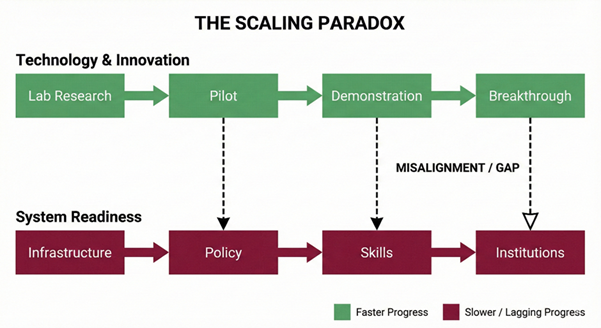
Demonstration projects multiply. Funding cycles renew. Headlines celebrate breakthroughs. Still, system-level transformation advances slowly, unevenly, and often far behind expectations. This disconnect—between technical success and societal uptake—forms the central paradox confronting sustainability innovation today.
It is this paradox that SEMS Voices | Edition 02 set out to examine.
When the Society for Energy, Materials & Sustainability invited Members and Associate Fellows to respond to a deceptively simple question—What actually scales?—the answers converged with remarkable clarity. Contributors did not argue that technologies fail. Nor did they dismiss innovation as overpromised. Instead, they returned again and again to a more uncomfortable truth:
Scaling fails when systems are ignored.
Across 57 submissions spanning academia, industry, policy, and early-career research, contributors described the same pattern from different vantage points: technologies are often introduced into environments that are structurally unprepared to receive them. Infrastructure lags innovation. Governance trails capability. Skills, incentives, and institutional ownership remain misaligned.
What follows is not a catalogue of technologies. It is a story about conditions—the conditions under which innovation stops being impressive and starts being consequential.
I. Energy Transition Without Shortcuts
Few fields illustrate the scaling dilemma more clearly than energy.
From advanced storage concepts to alternative fuels, contributors consistently pushed back against the search for singular “silver bullet” solutions. Instead, they emphasized contextual deployment and portfolio thinking.
Nurbol Ibadulla, PhD Fellow and Graduate Research Assistant at New York University / NYU Abu Dhabi, described how long-duration energy storage technologies—particularly organic redox flow batteries—offer compelling sustainability advantages over conventional lithium-based systems. Yet he cautioned that their future hinges less on electrochemistry than on supply-chain readiness, cost normalization, and standardized performance validation. Without these, even technically superior systems remain commercially fragile.
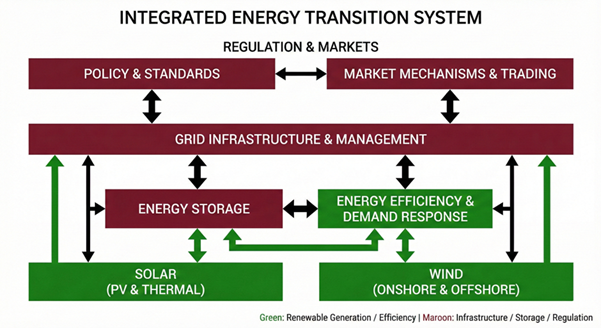
A similar realism emerged from Muhammad Adil, Master’s student at Dalian University of Technology. Working at the interface of renewable integration and grid systems, he noted that hybrid solar–wind–storage configurations already perform reliably under controlled conditions. Their limited adoption, he argued, reflects grid rigidity, regulatory fragmentation, and misaligned market incentives—not technical immaturity.
On the operational side, Mazhar Ul Haq, Operations Supervisor at Abraj Al Musbah Group, offered a grounded counterpoint. Some of the most scalable energy solutions, he suggested, are not novel at all. Energy efficiency measures in commercial and industrial facilities—demand response, control optimization, load management—deliver immediate impact, yet struggle for attention because they lack the visibility of new infrastructure projects.
Across these perspectives, a pattern emerges: energy technologies scale not when they promise transformation, but when they fit within systems that already exist—or when systems are intentionally redesigned to accommodate them.
II. Digital Power, Institutional Fragility
If energy transitions suffer from misplaced technological optimism, digital sustainability faces a different risk: overconfidence without governance.
Artificial intelligence, machine learning, and smart systems featured prominently across submissions, often framed as force multipliers for sustainability. Yet contributors were unusually cautious in their optimism.
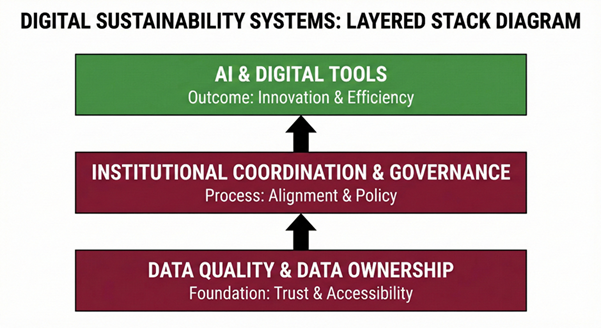
Syed Faheem Haider, Senior Lecturer at Sir Syed University of Engineering & Technology, described how smart infrastructure platforms routinely outperform expectations in simulations, but falter in practice due to fragmented data ownership and weak inter-agency coordination. Algorithms, he argued, cannot compensate for institutional silos.
From the perspective of scientific discovery, Sadaqat Ali, Engr., Dott., researcher at the National Institute of Chemistry, Slovenia, reflected on AI-assisted materials modeling. While digital tools accelerate hypothesis generation, he warned that insufficient experimental grounding can amplify uncertainty rather than reduce it. Without tight coupling between computation and validation, scalability becomes illusory.
Environmental intelligence raised similar concerns. Shabnum Masood, Research Scholar at BITS Pilani, highlighted how satellite data and remote sensing platforms already provide unprecedented visibility into climate and land-use dynamics. Yet decision-making often lags because institutions lack the expertise—or authority—to translate signals into action.
The consensus across digital submissions was strikingly consistent:
AI scales when institutions are ready. Otherwise, it simply exposes their weaknesses.
III. Materials That Perform
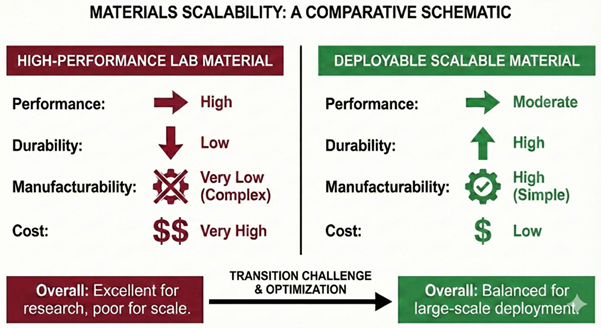
In materials science and separation technologies, contributors offered some of the most candid reflections in Edition 02. Performance metrics, they argued, too often dominate conversations that should be about durability, manufacturability, and integration.
Dasari Hindu Bhavani, PhD Scholar at REVA University, focused on membrane-based water treatment, where theoretical breakthroughs frequently overshadow deployable solutions. Single-layer graphene membranes, she noted, continue to attract attention due to exceptional modeled performance. Yet challenges in large-scale fabrication, defect control, mechanical robustness, and fouling resistance remain unresolved. In contrast, interfacially engineered polymeric and graphene oxide composite membranes—while less glamorous—already demonstrate scalable gains under realistic operating conditions.
Other contributors echoed this logic across catalysis and advanced materials. High activity under idealized laboratory conditions rarely survives exposure to complex feed streams, variable temperatures, and long operating cycles. Incremental improvements in stability, integration, and reuse consistently outperformed headline efficiency records when deployment was considered.
The message from materials researchers was clear and refreshingly honest:
Materials that scale are not those that win benchmarks, but those that survive systems.
What Actually Scales: A SEMS Synthesis
Viewed together, the perspectives in SEMS Voices | Edition 02 form a coherent position—one grounded not in theory, but in experience.
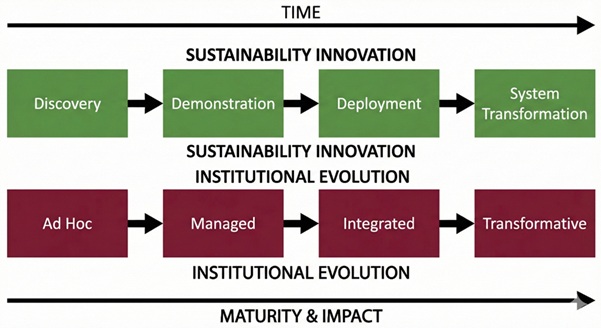
Technologies scale when infrastructure planning and innovation advance together.
Digital systems scale when governance, data integrity, and expertise are designed in from the start.
Materials scale when manufacturability and durability matter as much as performance.
Solutions scale when institutions, incentives, and skills evolve alongside technology.
In this sense, SEMS Voices occupies a space rarely captured in formal literature. It documents the knowledge that determines outcomes but seldom appears in journals: the knowledge of what fails quietly, what survives pressure, and what endures beyond pilots.
Looking Ahead
Edition 02 marks a maturation of SEMS Voices. The conversation has moved beyond identifying hype toward articulating the conditions under which innovation becomes impact.
Future editions will continue to expand this dialogue—drawing from diverse geographies, sectors, and career stages—while remaining anchored in one guiding principle:
Sustainability is not achieved by better technologies alone, but by better systems capable of using them well.
Acknowledgement
SEMS gratefully acknowledges all Members and Associate Fellows who contributed perspectives to Edition 02. While not all submissions could be featured, every response informed the synthesis presented here and strengthens the collective intelligence of the SEMS community.